

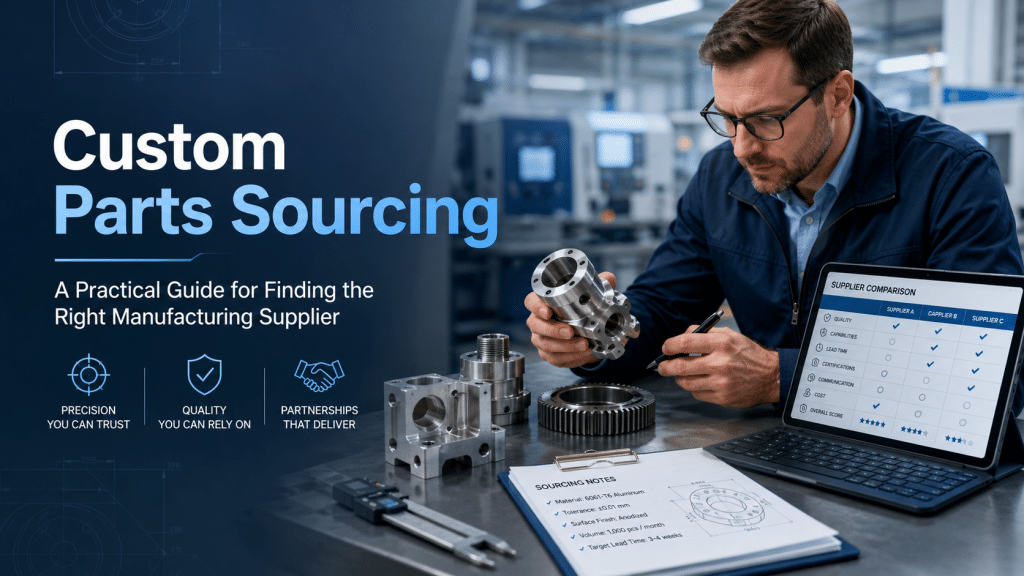
Target keyword: custom parts sourcing
Suggested meta title: Custom Parts Sourcing Guide | Find Reliable Manufacturing Suppliers
Suggested meta description: Learn how custom parts sourcing works, what to look for in a supplier, common mistakes to avoid, and how to reduce risk when sourcing manufactured components.
Sourcing custom parts is very different from buying standard parts off the shelf. When a component is made to your drawing, design, sample, or performance requirement, the supplier decision becomes much more important.
The wrong supplier can cause late deliveries, rejected parts, engineering delays, production problems, and unexpected costs. The right supplier can help you move faster, improve quality, and get exactly what your project requires.
That is why custom parts sourcing deserves a careful, structured approach.
Whether you are a procurement manager, engineer, startup founder, or operations leader, this guide will help you understand how to source custom parts more effectively and avoid common mistakes.
What Is Custom Parts Sourcing?
Custom parts sourcing is the process of finding and selecting a manufacturer to produce parts that are not standard catalog items. These parts are usually made to a specific drawing, CAD model, sample, material requirement, tolerance, finish, or application.
Custom parts may include machined components, fabricated metal parts, plastic parts, gears, castings, forgings, weldments, assemblies, prototypes, or replacement parts.
Unlike standard purchasing, custom parts sourcing requires matching the part’s requirements to the right manufacturing process and supplier capability. This means the buyer must consider more than price. They must also evaluate technical fit, quality systems, equipment, experience, communication, lead time, and capacity.
A strong sourcing process helps ensure the supplier can actually make the part correctly, consistently, and at a reasonable total cost.
Why Custom Parts Are Challenging to Source
Custom parts can be difficult to source because every project is different.
A simple-looking part may have a tight tolerance that requires specialized machining. A large welded frame may need distortion control and inspection planning. A small medical or electronic component may require micro machining expertise. A plastic part may need careful material selection, tooling design, or production-volume planning.
The complexity is not always obvious at first glance.
Another challenge is that suppliers often specialize. One manufacturer may be excellent at low-volume prototypes but too expensive for production. Another may be highly efficient at production runs but unwilling to take on small quantities. A third may have the right equipment but lack experience with your material, finish, or inspection requirements.
Custom parts sourcing is also difficult because suppliers may interpret RFQs differently. If the information provided is incomplete, each supplier may make different assumptions. This can produce quotes that are hard to compare.
For example, one supplier may include inspection documentation, special packaging, or finishing in the quote, while another may not. One may quote the exact material requested, while another may suggest an alternative. One may include tooling charges, while another may leave them out until later.
Without a clear process, buyers can easily compare quotes that are not truly equal.
Step 1: Define the Part Requirements Clearly
The first step in custom parts sourcing is to define what you need.
At minimum, the supplier should understand the part geometry, material, quantity, tolerances, finish, inspection requirements, and delivery expectations.
Useful information may include:
A 2D drawing, 3D CAD file, material specification, annual usage estimate, prototype quantity, production quantity, target lead time, required certifications, surface finish requirements, coating or plating requirements, packaging needs, and any critical-to-function dimensions.
The more complete the information, the better the supplier can quote the job accurately.
This does not mean every detail must be perfect before starting. In early product development, requirements may still be evolving. However, it is important to communicate what is known, what is flexible, and what is critical.
For example, some tolerances may be essential to performance, while others may be unnecessarily tight. A good supplier can often suggest design-for-manufacturing improvements, but only if they understand the function of the part.
Step 2: Identify the Right Manufacturing Process
Before choosing a supplier, it helps to understand which manufacturing process is likely to be the best fit.
Some parts are best made by CNC machining. Others may be better suited for casting, forging, stamping, fabrication, injection molding, additive manufacturing, or a combination of processes.
The right choice depends on several factors: geometry, material, strength requirements, tolerance, surface finish, production volume, tooling budget, and long-term cost targets.
For low-volume or prototype parts, machining may be the fastest and most flexible option. For high-volume plastic components, injection molding may be more cost-effective after tooling is justified. For strong metal components, forging may provide performance advantages. For large structures, welding and fabrication may be the most practical approach.
Choosing the wrong process can lead to unnecessary cost, long lead times, or poor performance.
This is one reason custom parts sourcing often benefits from experienced manufacturing input. A sourcing partner or knowledgeable supplier can help determine whether the selected process makes sense for the application.
Step 3: Build a Supplier Shortlist
Once the requirements and likely process are clear, the next step is to identify potential suppliers.
Many buyers begin with online searches. This can work, but it often produces a long list of companies that may or may not be relevant. Some suppliers rank well in search results because they are strong at marketing, not necessarily because they are the best fit for a specific part.
A better approach is to build a focused shortlist based on capability.
Consider whether the supplier has experience with the material, part size, tolerance range, production volume, and industry requirements. Review their equipment, quality systems, examples of work, and responsiveness.
For custom parts, fit matters more than size or name recognition. A smaller specialized shop may outperform a larger general supplier for certain parts. Likewise, a larger manufacturer may be better for production programs requiring capacity, documentation, and repeatability.
A sourcing partner like Proficient Sourcing can help narrow the search by recommending suppliers that are more likely to match the project from the beginning.
Step 4: Send a Complete RFQ
The RFQ, or request for quote, is where many custom parts sourcing projects succeed or fail.
A vague RFQ leads to vague quotes. A complete RFQ helps suppliers respond accurately and allows the buyer to compare options more fairly.
A strong RFQ should include the drawing or model, material, quantity, finish, inspection requirements, delivery location, target timing, and any special notes. It should also ask suppliers to identify assumptions, exclusions, tooling costs, lead time, and payment terms.
For complex parts, it can be helpful to ask suppliers whether they see any manufacturability concerns. This encourages feedback before production begins.
Buyers should also be careful not to send RFQs to too many suppliers at once. While it may seem efficient to contact dozens of manufacturers, this can create confusion and reduce response quality. A more focused RFQ list often produces better results.
Suppliers are more likely to engage seriously when they believe the opportunity is real and well matched to their capabilities.
Step 5: Evaluate Suppliers Beyond Price
Price is important, but it should not be the only deciding factor.
When comparing suppliers, consider the total value of the relationship. This includes quoted cost, lead time, communication, quality history, technical understanding, responsiveness, capacity, inspection capability, and willingness to support the project.
A low quote from an unqualified supplier can become very expensive if the parts are late, out of tolerance, or unusable. Rework, scrap, expedited shipping, engineering time, and missed production deadlines can quickly erase any initial savings.
Ask practical questions.
Does the supplier understand the drawing? Did they ask smart questions? Are they quoting the correct material and finish? Can they explain their process? Do they have experience with similar parts? Are they realistic about lead time? Do they have inspection equipment appropriate for the tolerances? Will they communicate if problems arise?
The best supplier is not always the cheapest. The best supplier is the one most likely to deliver acceptable parts on time at a fair total cost.
Step 6: Watch for Red Flags
During custom parts sourcing, certain warning signs should not be ignored.
One red flag is poor communication. If a supplier is difficult to reach before receiving the order, communication may get worse after the order is placed.
Another red flag is a quote that is dramatically lower than all others without a clear explanation. This may indicate that the supplier misunderstood the requirement, missed a detail, or plans to cut corners.
A supplier that does not ask questions on a complex part may also be a concern. Good suppliers often clarify tolerances, materials, finishes, inspection points, or production expectations.
Other red flags include vague lead times, unwillingness to discuss quality processes, lack of relevant experience, unclear terms, or frequent changes in quoted price.
Not every red flag means the supplier is bad, but it does mean the buyer should slow down and investigate before moving forward.
Step 7: Start With the Right Order Size
When working with a new supplier, it is often wise to begin with a prototype, sample run, or first article inspection before moving into larger production quantities.
This allows the buyer and supplier to confirm that the part can be made correctly before committing to a larger order.
For production parts, a first article process can help verify dimensions, materials, finishes, and documentation. For prototypes, early samples can reveal design issues or manufacturability concerns.
This step is especially important when the part is complex, the tolerance is tight, the material is unusual, or the supplier relationship is new.
Scaling too quickly with an unproven supplier can create avoidable risk.
Step 8: Think Long Term
Good custom parts sourcing is not just about solving today’s purchasing need. It is also about building a supplier base that can support future growth.
A supplier that is a good fit today should ideally be able to support repeat orders, design changes, production increases, quality documentation, and ongoing communication.
When evaluating suppliers, consider whether they are a short-term solution or a long-term partner. The answer may depend on your project. Sometimes a fast prototype supplier is exactly what you need. Other times, you need a production partner that can support years of demand.
Being clear about your long-term expectations helps avoid problems later.
How Proficient Sourcing Helps With Custom Parts Sourcing
Proficient Sourcing helps companies reduce the time and uncertainty involved in finding manufacturing suppliers.
Instead of asking buyers to search from scratch, Proficient Sourcing helps identify suppliers based on the specific custom part requirement. This is especially useful when the buyer needs a specialized capability, has limited time, or is unsure which supplier type is the best fit.
The process can help procurement teams find new supplier options, engineers locate technical manufacturing capabilities, and business owners move forward with more confidence.
For companies sourcing custom machined parts, large weldments, gears, plastic components, castings, forgings, or assemblies, having an experienced sourcing resource can make the process much easier.
The key advantage is focus. Rather than producing a long list of generic suppliers, Proficient Sourcing aims to help buyers connect with suppliers that are more closely aligned with the actual need.
Common Custom Parts Sourcing Scenarios
Custom parts sourcing may be needed in many situations.
A company may have a new product design and need prototype parts. An engineer may need a tight-tolerance component made from a difficult material. A procurement manager may need a second source because the current supplier is late or too expensive. A manufacturer may need a replacement part that is no longer available. A startup may need help moving from concept to manufacturable design.
Other common scenarios include low-volume production, supplier consolidation, domestic supplier search, emergency replacement parts, cost reduction projects, and sourcing for specialized manufacturing processes.
In each case, the sourcing challenge is slightly different. That is why a one-size-fits-all supplier search is rarely ideal.
Final Thoughts
Custom parts sourcing is one of the most important steps in turning a design, drawing, or production need into a finished component.
The process requires more than sending a drawing to a few random suppliers and choosing the lowest price. It requires understanding the part, selecting the right manufacturing process, building a qualified supplier shortlist, sending a clear RFQ, evaluating suppliers carefully, and managing risk before production begins.
For companies that do not have the time, network, or manufacturing knowledge to do this efficiently, working with a sourcing partner can be a practical advantage.
The right custom parts sourcing process saves time, reduces mistakes, improves supplier fit, and helps companies move from requirement to finished part with greater confidence.